Aluminum Sheet Metal Manufacturers: Mill, Service Center or Trader?
Search for aluminum sheet metal manufacturers and you will get forty companies in the first page of results, each claiming to manufacture. A few actually do. Others buy master coil in bulk, cut it into flat sheets, and resell. A fair number own nothing but a website and a price list. The quotes that come back for the same 2.0 mm 5052 sheet can differ by 25%, and the difference almost never announces itself. It shows up later, as camber in the brake, streaks under anodizing, or a mill certificate with a heat number that traces nowhere.
This guide is written from the producing side. It is about what the words manufacturer, supplier and factory actually hide in the flat sheet business, which spec lines decide whether the sheet works in your process, and when a service center is genuinely the better answer than a mill.
Four Businesses Share One Search Term
Whether you write aluminum or aluminium — the British spelling still dominates searches from the Gulf, India and Southeast Asia — the companies behind the results fall into four camps. A rolling mill casts aluminum, hot-rolls and cold-rolls it to gauge, and sells coil and flat aluminum sheet off its own production. A converter or service center buys master coil from those mills, slits it and cuts it to length, adding value through width selection, small lots and fast delivery. A trader sells from other people’s stock, sometimes adding inspection and logistics. And then there is the repacker, who is a trader with a warehouse and better photos.
None of these is automatically a bad choice. But the word each one uses for itself carries no information. A company called an “aluminum sheet metal factory” may be a service center with shears; a “supplier” may have its own hot mill. What matters is knowing which one you are talking to, because it decides what you can hold them accountable for. The mill controls metallurgy. The service center controls width, length, packaging and speed. The trader controls nothing except the invoice, which is fine as long as you know it.
What a Real Sheet Producer Actually Controls
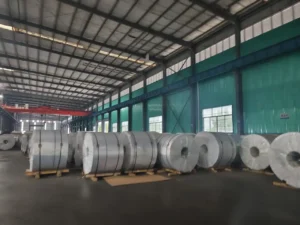
Flat sheet does not start flat. It starts as DC-cast ingot, gets scalped, pre-heated, hot-rolled down from hundreds of millimetres, then cold-rolled in several passes to final gauge, with annealing steps in between to set the temper. After rolling come tension leveling and cut-to-length lines that turn coil into sheets. Every one of those steps leaves a fingerprint the buyer can feel.
Cold rolling sets thickness — and more importantly, how even that thickness is across the width and along the coil. Annealing practice sets grain size, which shows up as orange peel on formed parts. Tension leveling decides flatness, which decides whether sheets feed cleanly into an automated line or jam every third blank. A service center inherits all of this and can fix none of it. That is the single most useful thing to understand about the sheet business: the expensive decisions were all made before the sheet was ever cut.
The Spec Lines That Decide Whether the Sheet Works
Alloy is the visible choice and usually the least misunderstood one. 1100 for chemical resistance and deep drawing. 3003 as the general-purpose workhorse. 5052 when you need strength plus formability, which is why it dominates sheet metal work in transport and marine. 5754 for European marine and structural sheet. 6061 when the part is structural and heat treatment is on the table. We have a separate comparison covering 3003, 3105, 5052 and 1100 for building products.
Temper is where buyers quietly lose money. H18 is full hard: strong, but it will crack on a tight bend. H14 splits the difference. H22 and H24 are annealed back after hardening and bend far better at nearly the same strength — which is why stampers ask for them by name. If a quote just says “H14” for an alloy you intend to bend, ask what bend radius the mill guarantees. Some will not answer, which is itself an answer.
Thickness tolerance matters more than thickness. ASTM B209 gives tolerance windows that widen with thickness and width, and a seller can legally ship 1.93 mm sheet against a 2.0 mm nominal. For most work that is fine; for calculated load-bearing parts or tight die clearances it is not. State the tolerance in the purchase order, not just the nominal gauge. Flatness deserves the same treatment: a sheet can measure perfect thickness and still fail on a feed line because it has a quarter-wave over its length that nobody specified.
Surface is the last variable, and the one that only matters once it has already cost you. Standard mill finish is fine for painting and most fabrication. Anodizing is not forgiving: rolling marks, die lines and streaks that are invisible under paint become visible under a clear anodic film. If the sheet is going to be anodized, say so before ordering — the mill will select better surface stock or roll to an anodizing-quality standard, and it will cost slightly more now instead of a lot more later.
Why Identical Quotes Differ by a Quarter
Three mechanisms explain most of the spread. First, tolerance gaming: selling at the bottom of the thickness window is free margin on every tonne, invisible unless you measure on arrival. Second, certificate discipline: a proper mill cert ties each coil to a heat number, measured thickness and temper verification; a photocopied generic cert ties it to nothing. Third, material origin: prime substrate from a known mill, re-rolled material, and off-grade stock can all carry the same alloy designation on paper. The last one is rare from reputable sellers, but the sheet business has a long tail of small players, and “rare” is not the same as “never”.
Documents Worth Demanding Per Lot
For flat aluminum sheet, the paperwork that matters fits on one page. A mill certificate with heat number, alloy, temper and measured thickness per coil. Confirmation of the tolerance standard named in your PO. If surface is critical, the agreed surface class in writing. ISO 9001 that applies to the actual producing plant, not the group headquarters of whoever sold it to you. And if the seller is not the producer, the name of the mill that rolled the coil — a seller who will not disclose that is telling you something.
When the Service Center Is the Better Answer
Mills sell campaigns. A service center sells convenience, and for many buyers that is exactly the right product: small quantities, a mix of alloys and gauges from one invoice, cut-to-length in stock widths, delivery measured in days instead of weeks. You pay a premium per kilogram and save it back on MOQ, freight and the working capital a five-tonne minimum would have frozen. The arrangement works well as long as one rule holds: the service center discloses the mill origin and can pass on the original mill certificate. Most good ones do this without being asked.
Frequently Asked Questions
Are aluminum sheet metal manufacturers and suppliers the same thing?
No, though every supplier would like you to think so. A manufacturer rolls its own material; a supplier may manufacture, convert, or simply resell. The distinction that matters commercially is not the label but whether the company can produce a mill certificate naming the producing plant, and whether it can hold itself to tolerances it does not physically control. Ask one question: who rolled this coil? Everything else follows from the answer.
Should I buy sheet or coil?
If you consume sheet in quantity and have a cut-to-length line or a supplier who blanks for you, coil is cheaper per tonne and gives you full control of sheet size. If you buy assorted sizes in small lots, pre-cut flat sheet from a converter is usually cheaper than it looks, once freight and minimum quantities are counted. We cover the terminology and the coil-versus-sheet decision in detail separately.
What minimum order quantities do sheet mills set?
Standard alloys in common gauges are often available from stock or short production runs in the 2–5 tonne range. Special widths, tempers or surface requirements move the number up. If a quoted MOQ feels wrong, the usual cause is that your specification forces a dedicated production run — changing width or taking a stock temper often changes the MOQ more than changing supplier does.
Which alloy should I use for bending and deep drawing?
For bending, 3003 and 5052 in an annealed-back temper (H22, H24) are the defaults, with 5052 chosen when the part needs strength. For deep drawing, 1100 and 3003 with generous radii. Full-hard tempers of any alloy will crack on sharp bends, which is less an alloy question than a temper question.
How do I verify thickness on arrival?
Measure with a micrometer at several points across the width, at both sheet ends, on at least three sheets per pack, and compare against the tolerance in your PO — not against the nominal gauge. Keep the readings with the pack number. If a claim ever comes, this is the evidence that moves it.
Send us your specification — alloy, temper, gauge, tolerance and destination market — and we will quote with the tolerance standard and surface class stated, plus the mill certificate that goes with the material.