
Architectural Aluminum Application · Qatar
Engineering Aluminum for Landmark Architecture
Inspired by the demanding architectural requirements of Lusail Stadium, YATAI presents a coated-aluminum solution approach for large-scale facades and roofing — combining color precision, fabrication performance and dependable production consistency.
Lusail, Qatar
Project location
2022 FIFA World Cup
Global landmark context
Facade + Roofing
Application focus
13,400 m²
Aluminum roofing system reported by LCP
2.7 g/cm³
Typical aluminum density
Project Overview
A Stadium Where Material Performance Meets Architectural Identity
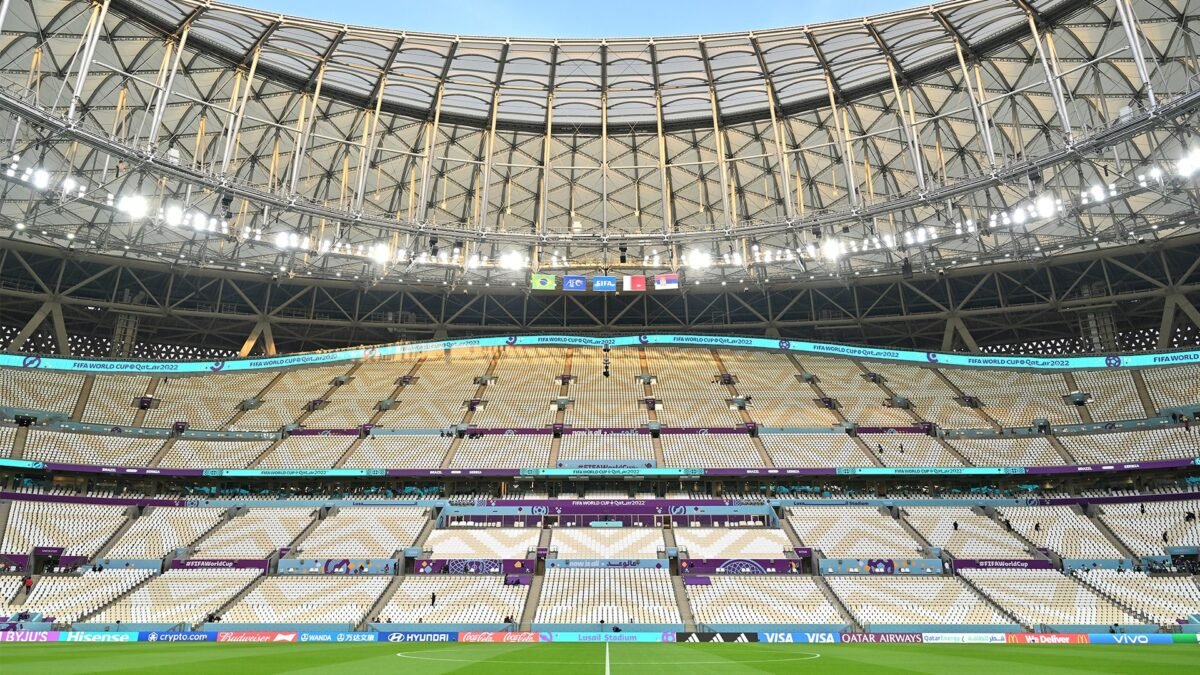
Lusail Stadium is one of Qatar’s most recognizable sports venues. Its golden exterior draws inspiration from traditional Arab bowls and lanterns, while its large-scale roof and envelope systems respond to the demands of a hot, sunny and dusty environment.
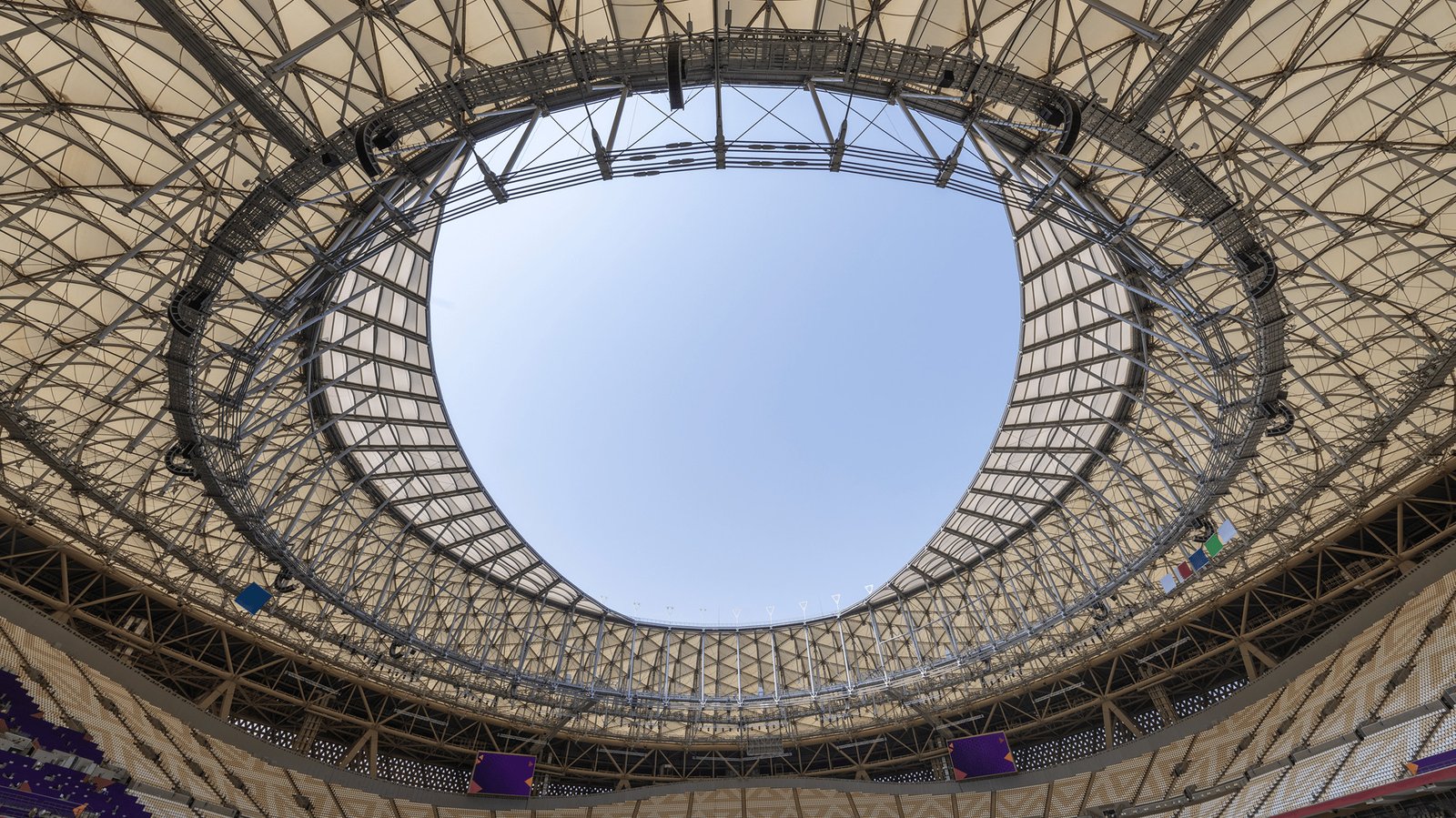
The stadium demonstrates how different materials work together: steel provides structural support, aluminum forms architectural facade elements, and a cable-supported PTFE membrane is used in the main roof design.
For aluminum coil manufacturers, the project offers a useful benchmark: architectural metal must deliver more than an attractive finish. It must also support accurate fabrication, consistent appearance, outdoor durability and reliable delivery.
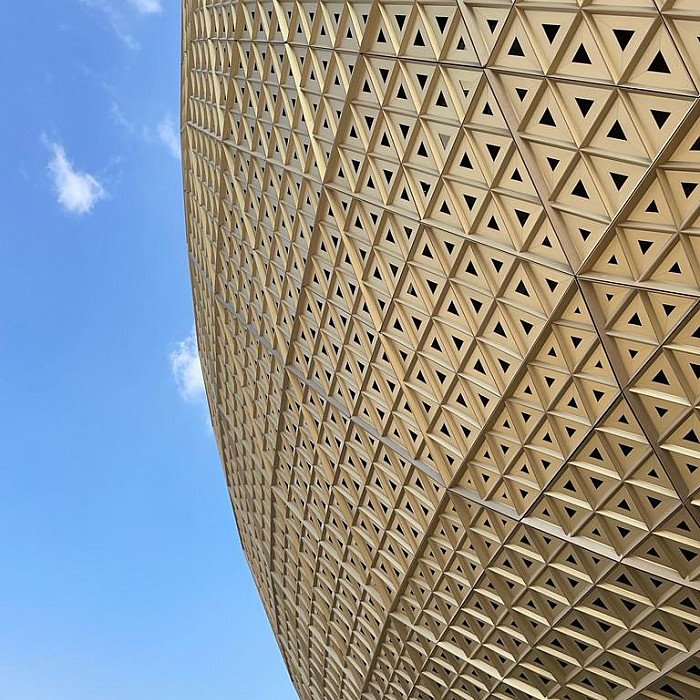
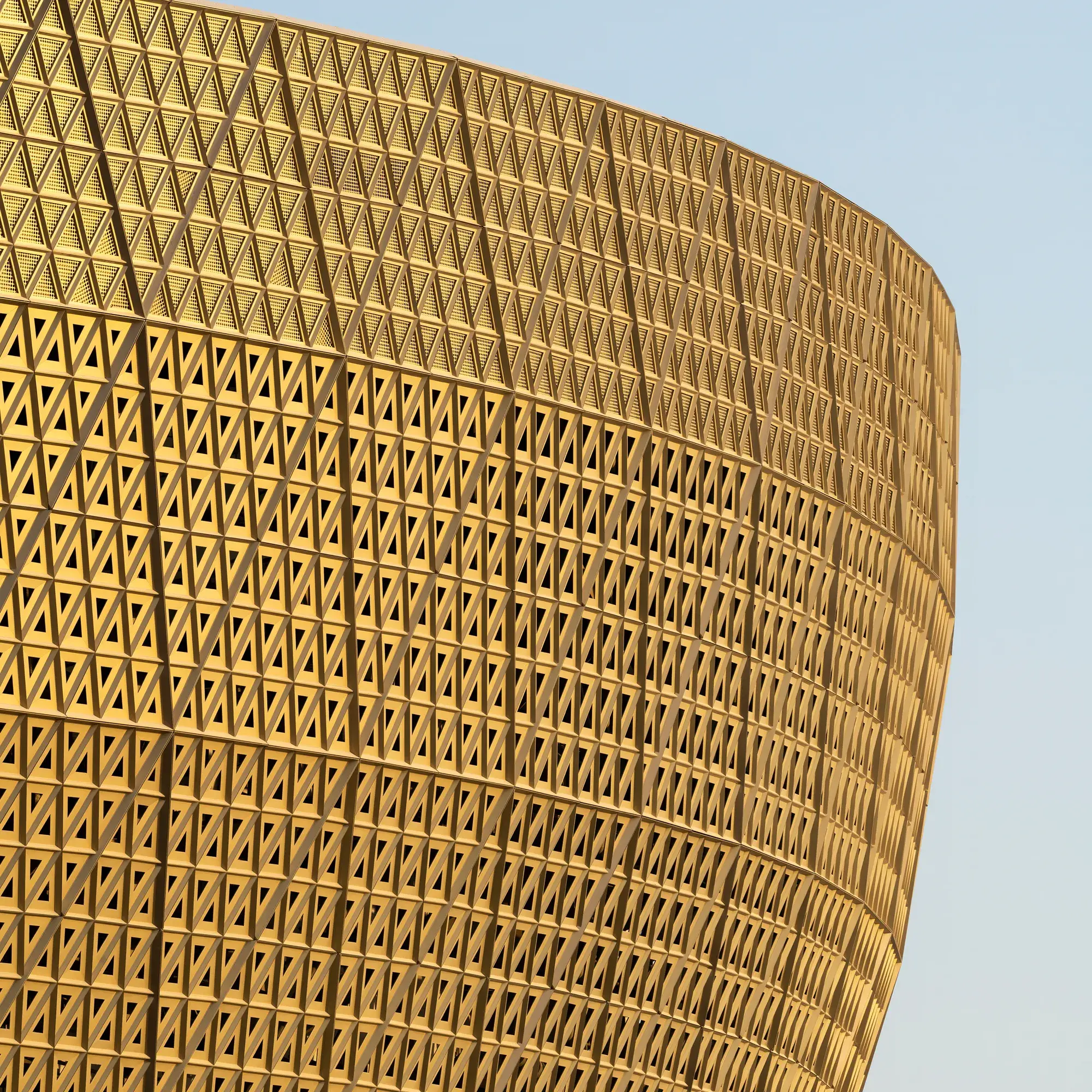
- Iconic gold-toned triangular facade screen
- Large-scale metal roofing and envelope coordination
- High exposure to solar radiation, heat and airborne dust
- Strict requirements for appearance, fit-up and long-term service
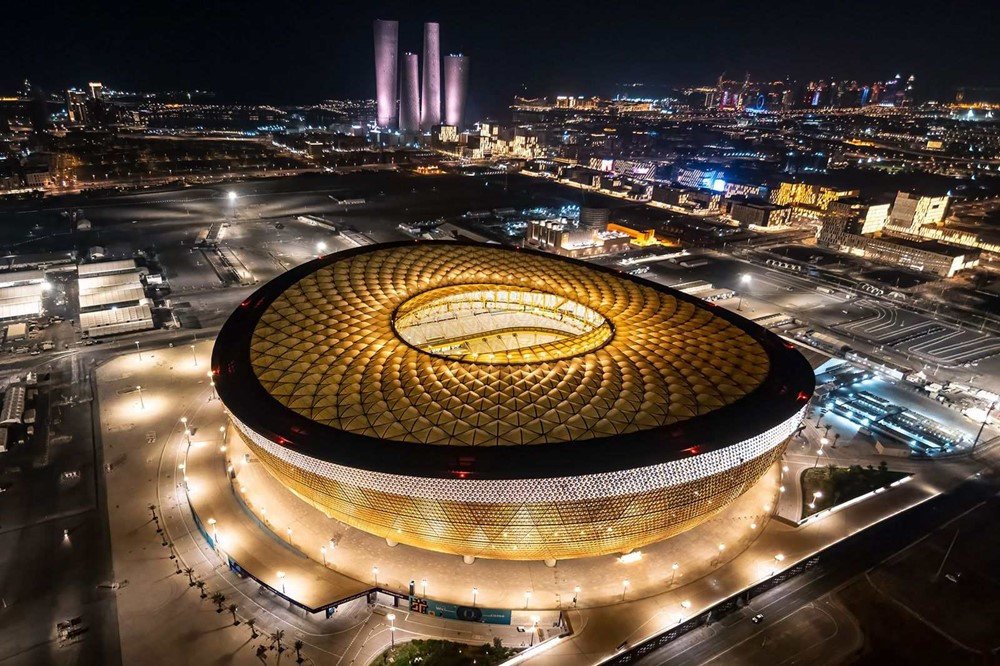
Lusail Stadium exterior photograph · image credit and commercial-use permission must be confirmed before publication.
Why Aluminum?
The Right Material for the Right Function
Aluminum does not replace the stadium’s primary steel structure. It complements the structure where lightweight cladding, architectural shaping and durable surface finishes are required.
01 / LIGHTWEIGHT
Lower Dead Load
With a typical density of about 2.70 g/cm³, aluminum weighs roughly one-third as much as steel by volume. Properly designed panels can reduce the load carried by secondary support systems.
Weight efficiency
02 / FORMABILITY
Design and Fabrication Freedom
Aluminum sheet can be cut, punched, folded and formed into custom facade components, supporting geometric screens, trims and architectural details.
Custom fabrication
03 / CORROSION
Outdoor Protection
Aluminum naturally forms a protective oxide film. A suitable architectural coating adds protection against UV exposure, moisture and environmental contaminants.
Coating durability
04 / APPEARANCE
Distinctive Surface Finishes
Coated aluminum supports solid, metallic, matte and textured finishes, helping the building envelope maintain a consistent architectural identity.
Color customization
05 / LIFECYCLE
Practical Service Performance
When alloy, coating, detailing and installation are correctly specified, aluminum facade and roofing components can provide dependable outdoor service with planned maintenance.
Lifecycle planning
06 / SYSTEM DESIGN
Material-System Integration
Aluminum panels work as part of a complete system that includes brackets, fasteners, joints, drainage and movement allowances — not as isolated sheet material.
System compatibility
Engineering Challenges
What Does a Landmark Project Demand from Aluminum?
Large architectural envelopes magnify small material inconsistencies. These challenges translate the stadium’s design context into practical requirements for coated aluminum coil and downstream fabrication.
Challenge 01
Complex Geometry and Accurate Fit-Up
Thousands of custom facade elements require stable sheet dimensions and predictable forming behavior. Variations in thickness, flatness or slit width can create difficulties during punching, folding and panel assembly.
Material response: specify alloy and temper for the actual forming process; control thickness and width tolerances; verify flatness; and test coating integrity after forming.
Challenge 02
Color Consistency Across Large Areas
Metallic gold, bronze or champagne finishes can look different under changing light and viewing angles. Batch-to-batch color, gloss and texture variation may become visible when panels are installed side by side.
Material response: approve a physical master sample, define the color measurement method, control gloss and texture, group production by batch and retain reference samples for repeat orders.
Challenge 03
Heat, UV and Environmental Exposure
In Gulf climates, facade and roofing materials experience intense solar radiation, high surface temperatures, dust and, in coastal locations, airborne salts. The coating system must be selected for the actual exposure category.
Material response: consider PVDF coating systems for demanding exterior applications, confirm coating thickness and adhesion, and request relevant accelerated weathering and corrosion test data.
Challenge 04
Thermal Movement and System Coordination
Aluminum expands and contracts as temperatures change. For a 2 m panel over a 60°C temperature change, theoretical linear expansion is approximately 2.76 mm, using a typical coefficient of 23 × 10⁻⁶/°C.
Material response: provide stable material dimensions and surface quality, while the facade or roofing designer sizes movement joints, sliding connections, fasteners and sealants for the complete system.
YATAI Material Solution
Coated Aluminum Coil Engineered for Architectural Fabrication
YATAI focuses on the upstream material that enables downstream manufacturers to produce reliable facade panels, roofing components and architectural aluminum products. The final specification is matched to the application, forming process and project environment.
Coating options
PVDF / PE
Architectural coating systems selected according to exposure, appearance and service requirements.
Maximum coil width
2,780 mm
Wide-format supply capability for specialized architectural applications.
Color control
ΔE ≤ 1.0
Color reproduction capability supported by experienced specialists and sample approval.
Production network
3 factories
Shandong headquarters, Guangdong factory and Egypt factory.
Coating capacity
8 lines
Automated high-speed coating lines supporting production continuity.
Quality framework
145 checks
Inspection framework and production records supporting verification and traceability.
Material performance depends on alloy, temper, coating system, thickness, fabrication method and installation design. Final specifications are confirmed against customer drawings and technical requirements.
Recommended Specification Framework
A Practical Starting Point for Gulf Architectural Projects
The following is an illustrative engineering starting point for discussions with facade and roofing fabricators. It is not the verified bill of materials or procurement specification of Lusail Stadium.
| Parameter | Facade Panel Coil — Indicative | Standing Seam Roofing Coil — Indicative |
|---|---|---|
| Alloy / Temper | 3003 H24 or 3105 H24, subject to forming design | 3004 H34 or 3105 H24, subject to system design |
| Thickness | 0.70–1.20 mm | 0.80–1.00 mm |
| Coating system | PVDF or project-approved architectural coating | PVDF exterior coating system |
| Top coating thickness | 25–30 μm, subject to specification | 25–30 μm, subject to specification |
| Back coating | 5–10 μm, subject to bonding / exposure | 5–10 μm, subject to system requirements |
| Color / finish | Custom metallic gold, bronze, champagne or solid | Project-matched solid or metallic finish |
| Color tolerance | Target ΔE ≤ 1.0 against approved reference | Target ΔE ≤ 1.0 against approved reference |
| Forming validation | T-bend, folding, punching and adhesion tests | Roll-forming trial, adhesion and surface inspection |
| Weathering validation | Project-specified UV and corrosion testing | Project-specified UV, humidity and corrosion testing |
Indicative values are starting points only. Alloy, temper, thickness, coating build and test criteria must be finalized by the project designer, panel fabricator and coating supplier. No single specification is suitable for every facade or roofing system.
From Coil to Building Envelope
How YATAI Supports the Fabrication Process
A reliable architectural finish starts well before installation. YATAI works with customers to align coil specifications, coating performance, color approval and production planning with downstream manufacturing requirements.
STEP 01
Project Review
Review drawings, end use, climate exposure, forming process and required standards.
STEP 02
Material Matching
Recommend alloy, temper, thickness, width and coating options.
STEP 03
Color Approval
Develop samples and confirm color, gloss and texture against the reference.
STEP 04
Controlled Production
Manage coating, slitting, inspection and production records.
STEP 05
Delivery Support
Coordinate packing, documentation and shipment requirements.
Why YATAI
A Manufacturing Partner for Demanding Aluminum Projects
YATAI combines specialized roller-coating experience with production scale, color development and quality management to support aluminum processors, facade manufacturers and roofing system suppliers.
22+ Years
Industry Experience
Experience in aluminum building materials R&D, production and sales.
100,000+ Tons
Annual Capacity
Manufacturing scale for ongoing and large-volume customer demand.
2,780 mm
Maximum Width
Wide-width coating capability for specialized applications.
4 Machines
Precision Slitting
High-speed precision slitting equipment for customer-specific widths.
COLOR DEVELOPMENT
Custom Color Solutions
Color specialists support custom matching, sample review and repeat-order color management.
QUALITY MANAGEMENT
Inspection and Traceability
A 145-item inspection framework and retained production data support quality verification.
GLOBAL SUPPLY
Three-Factory Network
Operations in Shandong, Guangdong and Egypt support manufacturing coordination and international service.
Your Project. Our Aluminum Expertise.
Planning an Architectural Aluminum Project in the Middle East?
Send us your drawings, target color, alloy, thickness, width and application details. YATAI’s team can help assess a suitable coated-aluminum coil specification and prepare samples for your project.