Why Coating Selection Decides the Fate of an Aluminum Project
In architectural aluminum, the coil is the body — but the coating is the lifespan. Two suppliers can deliver identical alloy, identical temper and identical gauge, yet one facade survives twenty years of coastal sun while the other fades within four summers. The difference is not the aluminum. It is the coating system, and whether it was specified for the environment it actually faces.
This guide covers the four mainstream coating systems used on painted aluminum coils — PVDF, polyester (PE), epoxy and FEVE — how each performs under UV, humidity and chemical exposure, and how to translate a project’s real-world conditions into a defensible specification. It is written for procurement engineers, facade consultants and building material distributors who need to justify a coating choice with data, not marketing language.
What “Painted Aluminum Coil” Actually Means in Production
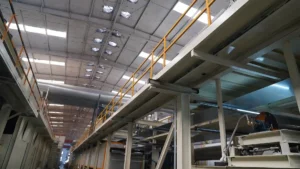
Before comparing coatings, it helps to understand what the coil has already been through. A painted aluminum coil is produced on a continuous coil coating line, where aluminum strip unwinds at speeds often exceeding 100 metres per minute through a sequence of stages:
- Cleaning and pretreatment — alkaline degreasing followed by a conversion coating (chromate-free or chrome-based) that creates the chemical bond between metal and paint.
- Primer application — typically 5–7 μm, applied to one or both sides, cured in an oven.
- Topcoat application — 18–25 μm for architectural grades, applied by roller and cured at peak metal temperature (PMT) between 220 °C and 250 °C.
- Back coat — 5–8 μm, protecting the reverse face and providing a bonding surface for adhesives or laminates.
- Quenching, inspection and recoiling — with continuous thickness gauging, color measurement and adhesion spot checks.
Two numbers matter most in a specification: total dry film thickness (DFT) and peak metal temperature. Under-cured coating will pass a visual inspection and fail a bend test two months later. Always request the DFT record and the cure window from the mill, not just a certificate of conformity.
The Four Coating Systems Compared
| System | Typical DFT | UV Resistance | Service Life (exterior) | Best For |
|---|---|---|---|---|
| PVDF (70% Kynar 500®) | 23–28 μm | Excellent | 20–25 years | Curtain walls, facades, coastal and high-UV sites |
| Polyester (PE) | 18–22 μm | Moderate | 8–12 years | Interior panels, gutters, short-cycle products |
| Epoxy | 15–20 μm | Poor | Interior only | Primer layers, internal ducting, backing coats |
| FEVE | 25–30 μm | Very good | 15–20 years | Curved forms, complex geometry, high-gloss finishes |
PVDF: The Architectural Benchmark
Polyvinylidene fluoride resins at 70% concentration (commonly Kynar 500® or Hylar 5000®) remain the reference standard for exterior architectural metal. The fluoropolymer bonds resist UV-induced chain scission, which is why PVDF retains gloss and color far longer than polyester. A properly cured 70% PVDF system on a chromate-free pretreatment will typically deliver a 20-year colour warranty with a ΔE of 5 or lower.
The practical caveat: not all “PVDF” is 70%. Some mills blend fluoropolymer at 50% or lower to reduce cost. Ask for the resin percentage on the mill certificate. A 50% system behaves very differently from a 70% system after year eight.
Polyester: Right for the Right Job
Polyester coatings are economical, formable and available in an enormous color range. They are the correct choice for aluminum gutter coil and interior applications where UV exposure is limited. The failure mode of polyester is chalking followed by color fade — gradual, predictable, and acceptable if the specification anticipated it.
Specifying PE for a south-facing facade in a high-altitude climate is a decision that will surface as a warranty claim in year six. Specify it for gutters, soffits and interior work, and it performs exactly as intended.
FEVE: For Geometry That Punishes Ordinary Coatings
Fluoroethylene vinyl ether coatings hold gloss better than PVDF and tolerate bending and deep drawing without cracking — useful for curved facade panels and complex extrusions. The trade-off is cost and a narrower color palette.
How to Match Coating to Environment: A Practical Matrix
The most common specification error is choosing a coating by price per square metre rather than by exposure. Use the matrix below as a starting filter, then confirm with the mill.
| Exposure Condition | Recommended System | Minimum DFT | Key Risk if Under-Specified |
|---|---|---|---|
| Coastal, within 5 km of saltwater | 70% PVDF + chrome or high-performance Cr-free pretreatment | 25 μm | Edge corrosion, filiform blistering |
| Industrial / high SO₂ atmosphere | 70% PVDF, chemical-resistant primer | 25 μm | Chalking, acid etching of topcoat |
| High UV (tropical, high altitude) | 70% PVDF or FEVE | 25 μm | Rapid color fade, gloss loss |
| Temperate urban facade | 70% PVDF or high-durability PE | 23 μm | Premature chalking after 10 years |
| Roofing and gutter, moderate climate | PE or modified polyester | 20 μm | Fade acceptable; adhesion is critical |
| Interior ceiling, soffit, duct | PE or epoxy primer | 18 μm | Minimal — cost optimization applies |
Six Tests That Separate a Real Specification from a Sales Sheet
Any mill can produce a datasheet. These six tests are what distinguish a coating that will last from one that will be repainted:
- Adhesion (cross-hatch, ISO 2409) — should reach class 0 or 1 both before and after a 2-hour boil water immersion.
- T-bend flexibility (ISO 5402) — architectural PVDF should pass 1T to 2T without cracking at the film thickness specified.
- Impact resistance — measures whether the coating survives a reverse impact without disbonding from the substrate.
- Salt spray (ISO 9227) — 1,000 hours minimum for coastal grades, with no blistering more than 2 mm from a scribe.
- Accelerated weathering (QUV or Xenon arc) — 2,000 hours with ΔE reported numerically, not described as “good”.
- Solvent rub (MEK double rubs) — confirms the coating reached full cure at the specified PMT.
Request these results for the specific lot you are buying, not a generic type test from 2019. Coating performance is a process outcome; lot-level data is the only meaningful evidence.
Handling, Storage and Fabrication: Where Good Coils Fail
A 25-year coating warranty is void if the coil is stored badly or fabricated incorrectly. Three failure points account for most premature damage:
Storage
Store coils indoors, on a flat surface, on dunnage that allows air movement. Never stack coils directly on top of each other without interleaving protection. Moisture trapped between wraps causes white rust and, on coated stock, interleaving stain that is invisible until after fabrication.
Cutting and Bending
Cut edges are the coating’s exposed boundary. On coastal projects, specify edge sealing or design to keep cut edges out of water paths. Bending radius should not go below the minimum specified for the coating and thickness; a reverse bend on a 23 μm PVDF film at 0.5 mm gauge will crack even on premium stock.
Fastening and Compatibility
Dissimilar metals in contact create galvanic couple. Use stainless or coated fasteners, and isolate aluminum from copper, brass and untreated steel. This single detail causes more facade staining than coating quality ever does.
Color, Gloss and the Language of a Coating Order
Color matching is where procurement and production most often misalign. A “RAL 9010” reference is a starting point, not a specification. Three parameters must be agreed in writing:
- Color standard and tolerance — typically ΔE ≤ 2 within a lot, ΔE ≤ 3 across lots, measured on a spectrophotometer under D65 illumination.
- Gloss level — 30% ± 5 at 60° is standard for architectural matte; specify numerically, never as “matte” or “satin” alone.
- Surface texture — smooth, embossed, or structured. Texture masks minor handling marks and is often specified for high-traffic facades.
For special finishes — wood grain, stone effect, metallic — request physical approval panels from the actual production run, not digital renders. Print-based and sublimation finishes vary meaningfully between runs.
Frequently Asked Questions
How long does a painted aluminum coil last outdoors?
With 70% PVDF at 25 μm DFT on properly pretreated substrate, expect 20–25 years of exterior service life in a moderate-to-severe environment. Polyester at 20 μm typically delivers 8–12 years before significant fade. Actual life depends far more on environment and pretreatment than on the resin alone.
Is 70% PVDF worth the cost premium over polyester?
For any exterior facade with high UV or coastal exposure, yes — the cost delta is usually 15–25% on the coil, while repainting a facade costs multiples of that and carries disruption. For gutters, soffits and interiors, polyester is the correct engineering choice.
Can painted aluminum coils be used for roofing?
Yes, and it is one of the most common applications. Roofing demands attention to two details: the coating must tolerate thermal cycling on the fixing points without cracking, and cut edges at laps must be designed to shed rather than trap water.
What thickness of coating should I specify?
For architectural exterior applications, 23–28 μm total DFT for PVDF, and 18–22 μm for polyester. Thinner films reduce UV protection proportionally; thicker films can become brittle and fail bend tests. Thickness is a window, not a maximum.
Does color affect coating durability?
Yes, measurably. Dark colors absorb more heat and accelerate degradation; light colors and especially whites with infrared-reflective pigments run cooler and last longer. On high-exposure facades, a light color in a 70% PVDF system is the most durable combination available.
Specifying With Confidence
Coating selection is an engineering decision with a twenty-year consequence. The process is straightforward once it is framed correctly: identify the environment, select the system that matches it, specify DFT and cure numerically, demand lot-level test data, and control handling after delivery.
At Yatai Aluminum, we produce painted aluminum coils in PVDF, polyester and FEVE systems on continuous coil coating lines, with full DFT and cure records supplied per lot and third-party test reports available on request. If you are working through a facade specification and need to validate a coating choice against your project’s exposure conditions, our technical team can review the requirement and propose a matching system — including color approval panels from production stock.
Talk to our engineers about your coating specification → share your environment, panel geometry and required service life, and we will return a concrete recommendation with supporting test data.